Browse documentation
Webhooks
Developer > Integrations > Webhook. A webhook lets Invunion call your systems when something happens, such as a transaction arriving or an invoice being paid. You add an endpoint, choose the events, and Invunion sends each one as a signed JSON request.
Everything a developer needs to know is in the API documentation. Its last section, the webhooks reference, has the event payloads, the signature code and the events API. This page covers only what you do on the screens in the app.
The page has two parts: the Webhook endpoints at the top, and the Delivery log below.
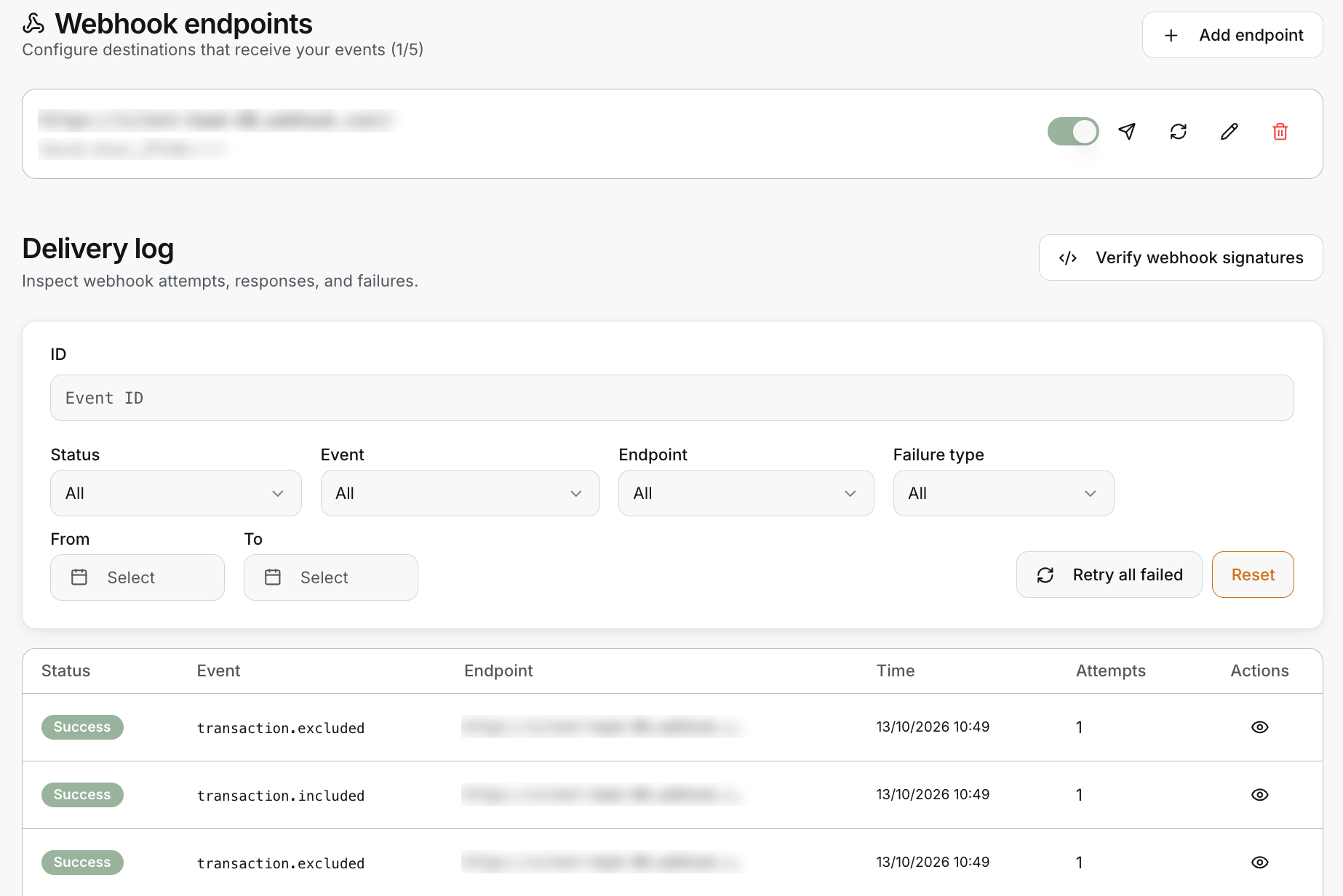
Each endpoint is one card. It shows its URL, the start of its signing secret, and a switch to turn it on or off. The four icons on the right send a test, rotate the secret, edit and delete. The title counts your endpoints, for example 1/5.
Add an endpoint
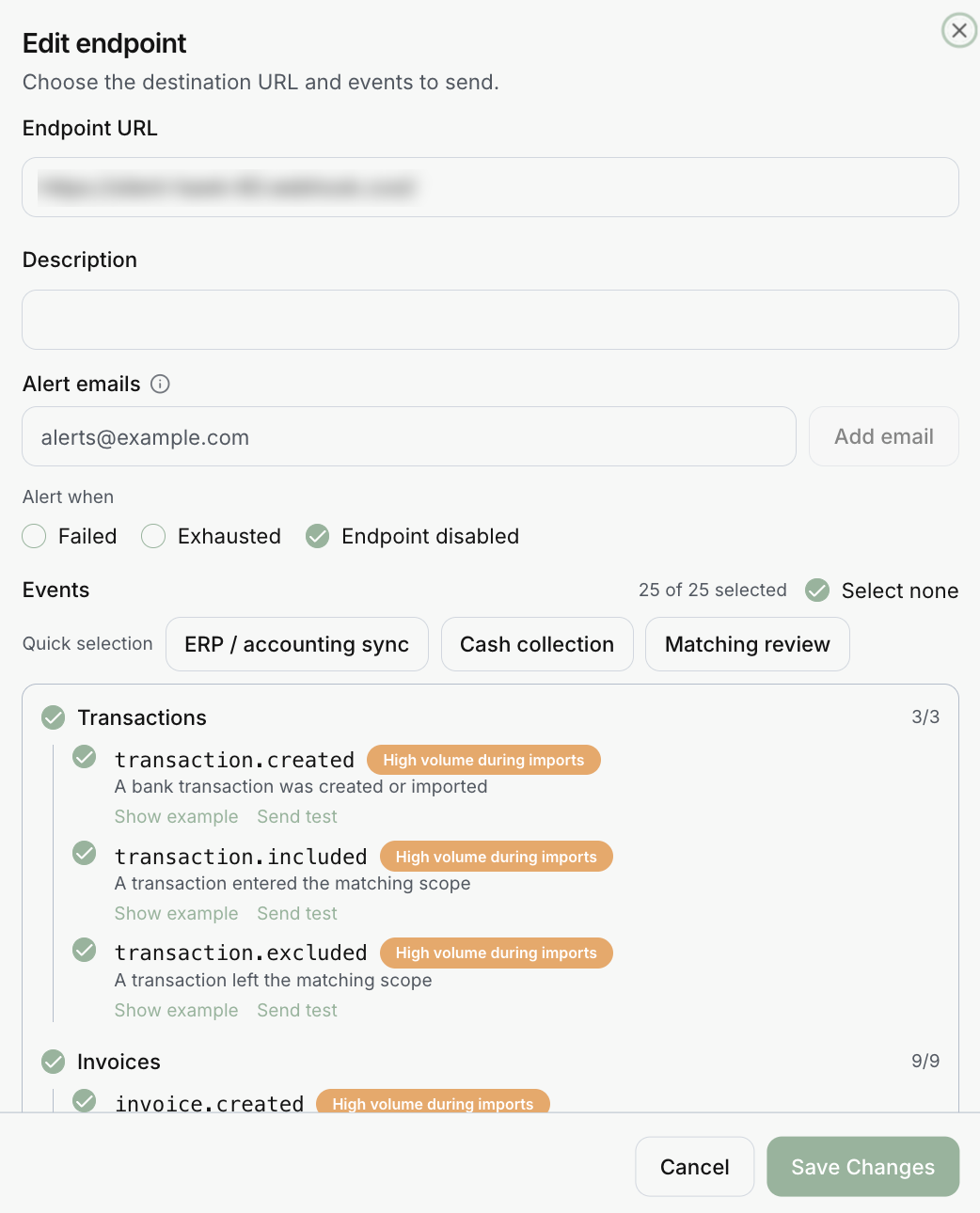
Select Add endpoint. The same form opens to edit an existing endpoint.
| Field | What it does |
|---|---|
| Endpoint URL | Where Invunion sends the events. It must be HTTPS and a public host. A private or invalid address is rejected. |
| Description | Optional, for your own reference. |
| Alert emails | Up to five addresses that Invunion emails when a delivery reaches a status you select. |
| Alert when | The statuses that trigger an alert email: Failed, Exhausted and Endpoint disabled. Only Endpoint disabled is selected by default. |
| Events | The events to send, grouped by category. Pick at least one. The counter shows how many are selected. |
An Entity can have up to five endpoints, active or inactive. Switch one to inactive to pause it without deleting it.
Choose the events
Use Select all or Select none, or start from a Quick selection:
| Quick selection | Selects |
|---|---|
| ERP / accounting sync | All invoice and counterparty events. |
| Cash collection | Invoice settlement changed and invoice settled. |
| Matching review | All match events. |
Each event shows what it means, a Show example link for a sample payload, and Send test. A few events carry a High volume during imports badge, because an import can create hundreds. Subscribe to them only if you need every record.
| Category | Events |
|---|---|
| Transactions | created, included, excluded |
| Invoices | created, updated, settlement changed, settled |
| Matching | created, suggested, confirmed, rejected, cancelled |
| Counterparties | created, updated, deleted, bank account linked |
| Banking | bank connected, bank disconnected |
| Synchronization | completed, failed |
The two settlement events cover invoices and credit notes alike:
- Settlement changed is sent each time a payment, credit note, refund or adjustment is added to or removed from a document, so every installment and every undone match sends one.
- Settled is sent when nothing is left to pay, whatever mix of payments and credit notes settled it.
They replace the former paid, partially paid, fully credited, partially credited, mixed settlement, credit note applied and credit note refunded events. An endpoint that was subscribed to any of those now receives both new events. The webhooks reference explains their payload.
Signing secret
When you create an endpoint, Invunion shows its signing secret once. Copy it and confirm that you saved it. It cannot be shown again. Rotate secret creates a new one, and the old one stops working immediately, so update your receiver first, or at the same time.
Each request carries an x-invunion-signature header made from a timestamp and an HMAC of the exact raw body. Verify it before you parse the JSON, and reject a timestamp more than five minutes old.
Receive events
- Answer with a
2xxpromptly. Each request has a 10 second limit and redirects are not followed. Do the heavy work afterwards. - Delivery is at least once. Use the event
idto ignore duplicates. - The
sequencenumber increases per Entity. Use it with the events API to catch up after an outage of your receiver. Events stay available for at least 45 days. - Optional batching sends up to 100 events in one request.
Test
- Send test on an endpoint sends a
webhook.testevent. - Send test next to an event sends a realistic example of that event, marked
"test": true. It is never mixed with real data.
Delivery log
The Delivery log shows every attempt. Filter it by event ID, status, event, endpoint, failure type and dates, then select Reset to clear the filters. The eye icon opens a row, with the request payload, the response and the attempts. Retry all failed queues every failed delivery again, and Verify webhook signatures shows how to check the signature of a request.
| Status | Meaning |
|---|---|
| Pending, Delivering | Waiting or in progress. |
| Success | Your endpoint answered 2xx. |
| Failed | Will be retried. |
| Exhausted | All attempts used. Resend webhook to try again. |
| Failure type | What to do |
|---|---|
| Rate limited | Your receiver answered 429 or 503. Delivery pauses and retries by itself. |
| Rejected | Your receiver answered 4xx. Check the URL and how it reads the payload. |
| Timeout | No answer within 10 seconds. Acknowledge fast and process later. |
| Invalid URL | The address is not allowed. |
Failed deliveries are retried after about 1 minute, 5 minutes, 30 minutes, 2 hours and 6 hours. Invunion sends at most 5 requests at once to an endpoint. Finished deliveries are kept for 30 days. An endpoint that keeps failing for days can be disabled automatically.
Limits to keep in mind
- An Entity can have 5 webhook endpoints, active or inactive.
- A lost signing secret cannot be shown again. Rotate the secret.
- Payment methods do not send events, and neither do the default system counterparties.
- An event is recorded only while an active endpoint or notification rule is subscribed to its type. A new endpoint does not replay the past.
Updated · View as Markdown