Browse documentation
Identification rules
Settings > Administration > Rules. Identification rules link a transaction to a counterparty or a payment method. They do not match it with an invoice.
How the rules work
Each rule does three things:
- Read from: picks the field of the bank line to read.
- Extract: cuts the value out of that field.
- Match on: looks that value up among your payment methods or counterparties.
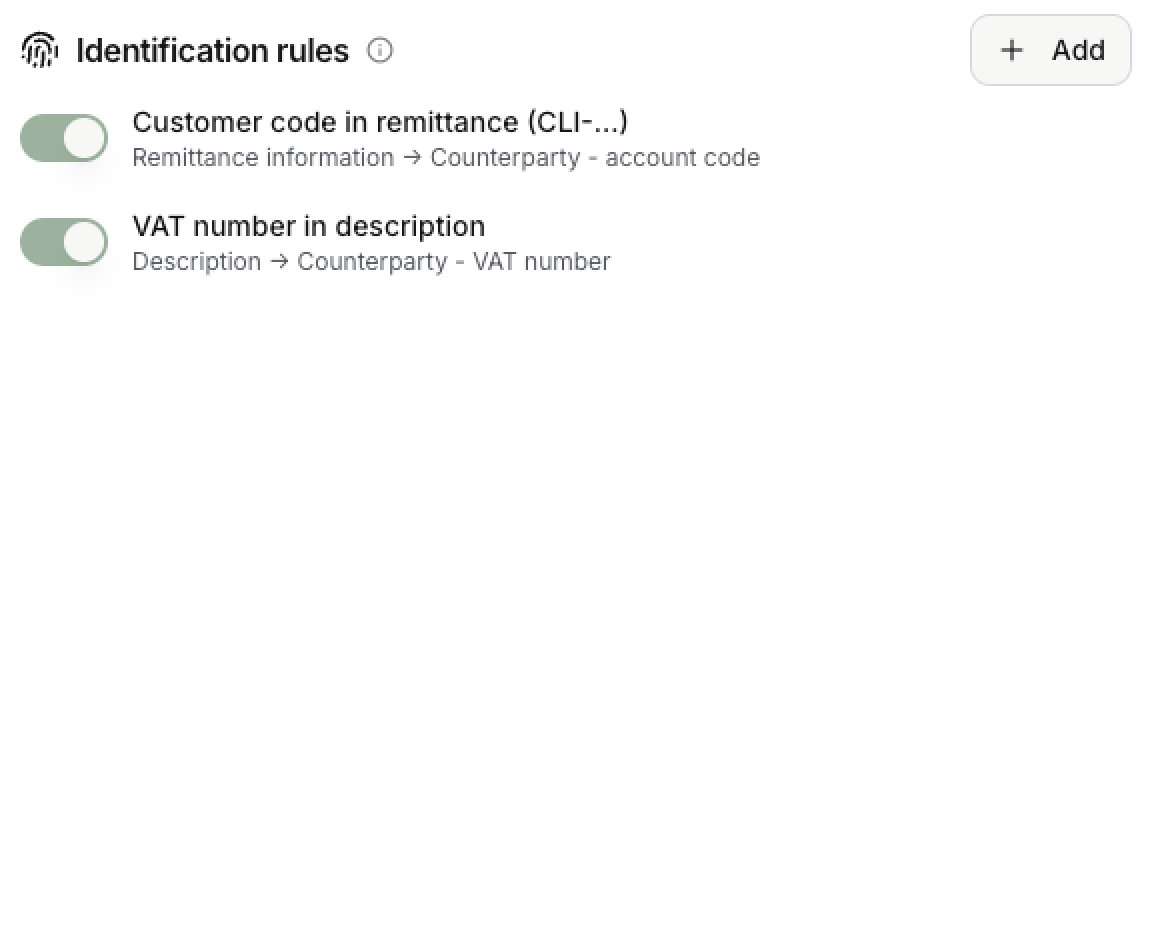
Add a rule
Select Add. The rule form has these fields.
| Field | What it does |
|---|---|
| Name | A label for you. |
| Read from | Remittance information, structured reference, external reference, description, or a transaction metadata key. |
| Extract | Whole value keeps the field as it is. Text after a prefix keeps what follows a prefix you give, ignoring case. Regular expression keeps the part that matches a pattern. |
| Match on | Where the value is looked up: a payment method IBAN, identifier or code, or a counterparty account code, VAT number, external reference or metadata key. |
| Active | Switch a rule off without deleting it. |
With a regular expression, Invunion keeps the first group in brackets when there is one, and the whole match otherwise. The pattern is case-sensitive and limited to 200 characters.
The form also has Test on a sample text. Paste a bank line, and the part the rule finds is highlighted, with the captured value and where it is looked up. The test is not saved.
Example with the test dataset
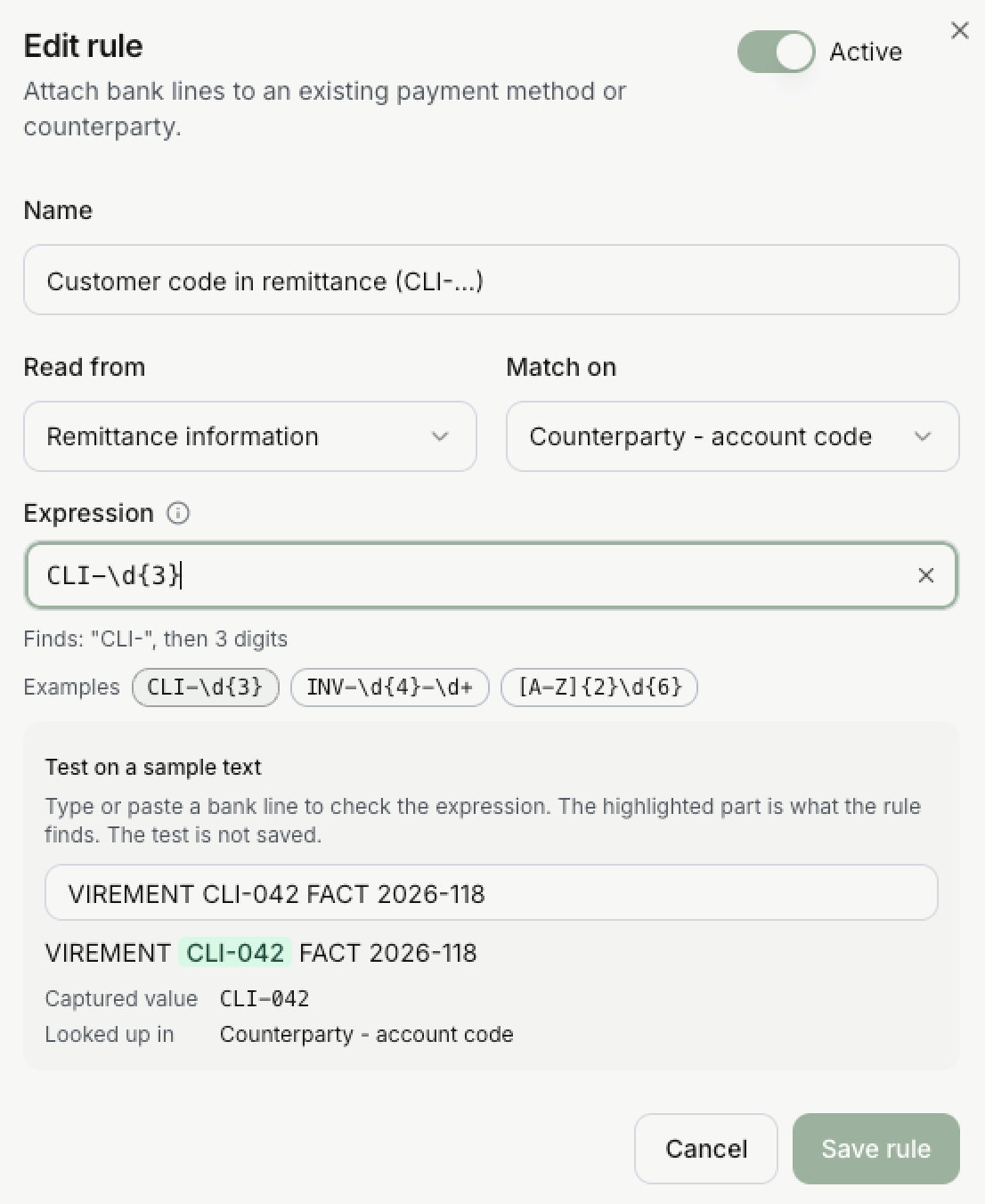
The test dataset names its customers with account codes from CLI-001 to CLI-010. The sample setup includes a rule for a bank line whose remittance carries such a code.
| Setting | Value | Why |
|---|---|---|
| Read from | Remittance information | The customer code is written in the remittance of the bank line. |
| Extract | Regular expression CLI-\d{3} | CLI- followed by exactly three digits. \d means one digit. |
| Match on | Counterparty - account code | The value found is compared with the account code of your counterparties. |
Take the sample text VIREMENT CLI-042 FACT 2026-118:
- The rule scans the text and finds
CLI-042. It is highlighted in the test. FACT 2026-118is ignored: it does not start withCLI-.- The captured value is
CLI-042. The pattern has no brackets, so the whole match is kept. - The rule looks it up in Counterparty - account code. If a counterparty has the account code
CLI-042, the bank line is attached to it, even without a known IBAN.
The second rule in the list works the same way. It reads the description, finds a VAT number such as FR81452100301 with the pattern [A-Z]{2}[0-9A-Z]{8,12}, and looks it up in Counterparty - VAT number.
What saving does
Changes apply to the next matching run and to live Match inbox suggestions. Matches already stored are never rewritten.
Limits to keep in mind
- A bank description that looks like a customer name is not proof of identity.
- Aggregator payment rails may serve many counterparties, so a payment method is not always owned by one party.
- A pattern that is too loose can find the wrong value. Test it on a few real bank lines first.
Updated · View as Markdown