Browse documentation
Counterparties
Counterparties in the menu. A counterparty is a company or a person you deal with. Most of the time it is a customer: someone you send invoices to and who pays you.
Invunion links every invoice and every bank transaction to a counterparty. That is how it knows who paid.
How counterparties work
Each counterparty has three things:
- Who it is: a code, a name, a VAT number, an address.
- What it is to you: one or more roles, such as Customer or Supplier.
- How it pays: a status for today and a payer score for the last 12 months.
The Counterparties list
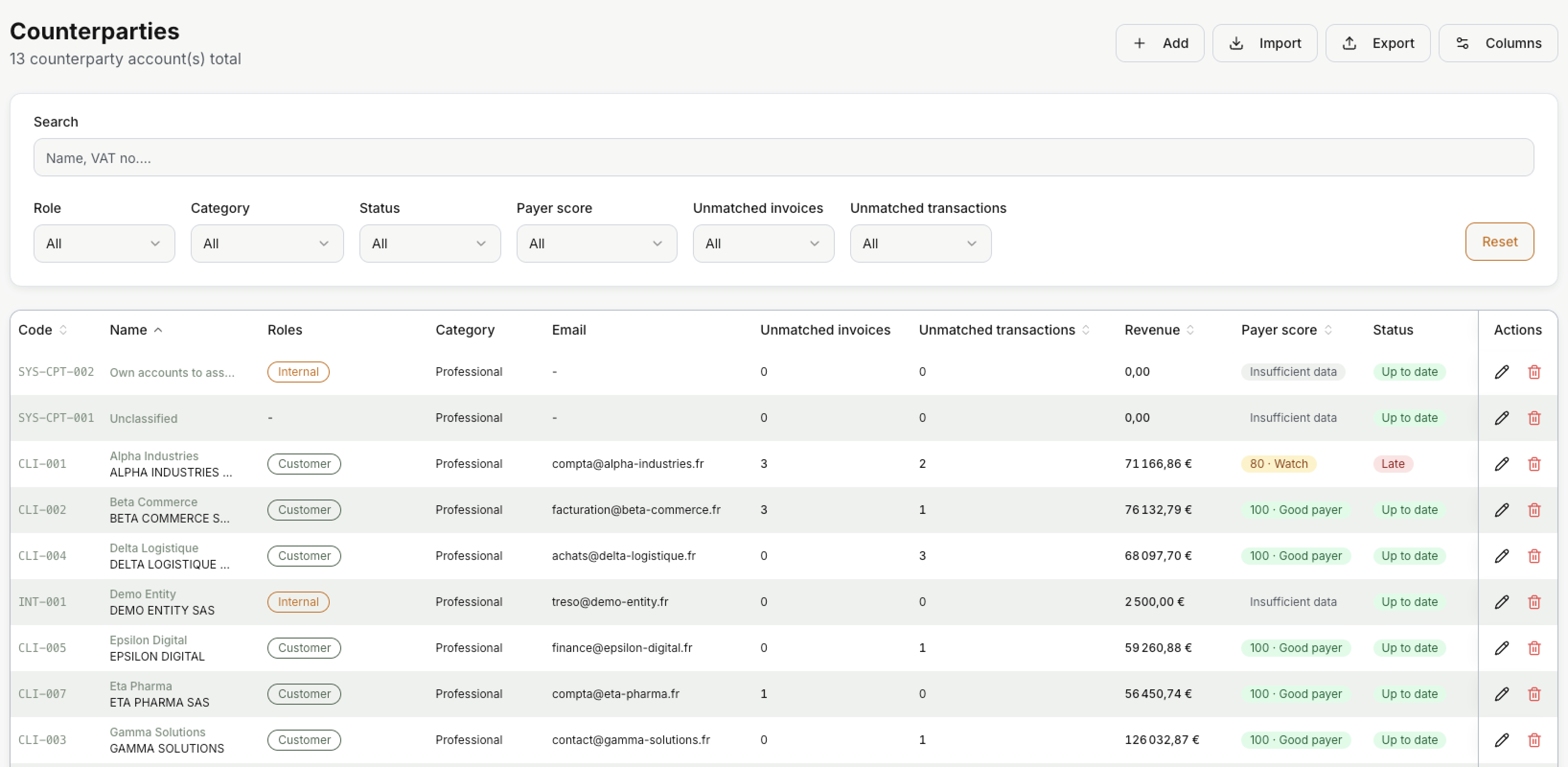
Each line is one counterparty. The buttons at the top:
| Button | What it does |
|---|---|
| Add | Create one counterparty by hand. |
| Import | Create many at once from a CSV file. |
| Export | Download the list. |
| Columns | Show or hide columns. |
Search looks in the name, display name, VAT number, code, city and country. The filters narrow the list by Role, Category, Status, Payer score, and whether there are Unmatched invoices or Unmatched transactions. Reset clears them all.
| Column | What it shows |
|---|---|
| Code | The counterparty code, for example CLI-001. |
| Name | The display name on top, the original name below. |
| Roles | The roles of the counterparty. |
| Unmatched invoices | Invoices still to be paid: unpaid, partly paid or overdue. Credit notes are not counted. |
| Unmatched transactions | Bank transactions of this counterparty with an amount still to settle. |
| Revenue | The total of the money received from this counterparty, per currency. |
| Payer score | How well they paid over the last 12 months. See Payer score. |
| Status | If an invoice is overdue today. See Status. |
| Icon | What it does |
|---|---|
| Opens the counterparty in the edit panel. | |
| Deletes the counterparty. The system counterparties cannot be deleted. |
Add or edit a counterparty
Select Add, or on a line.
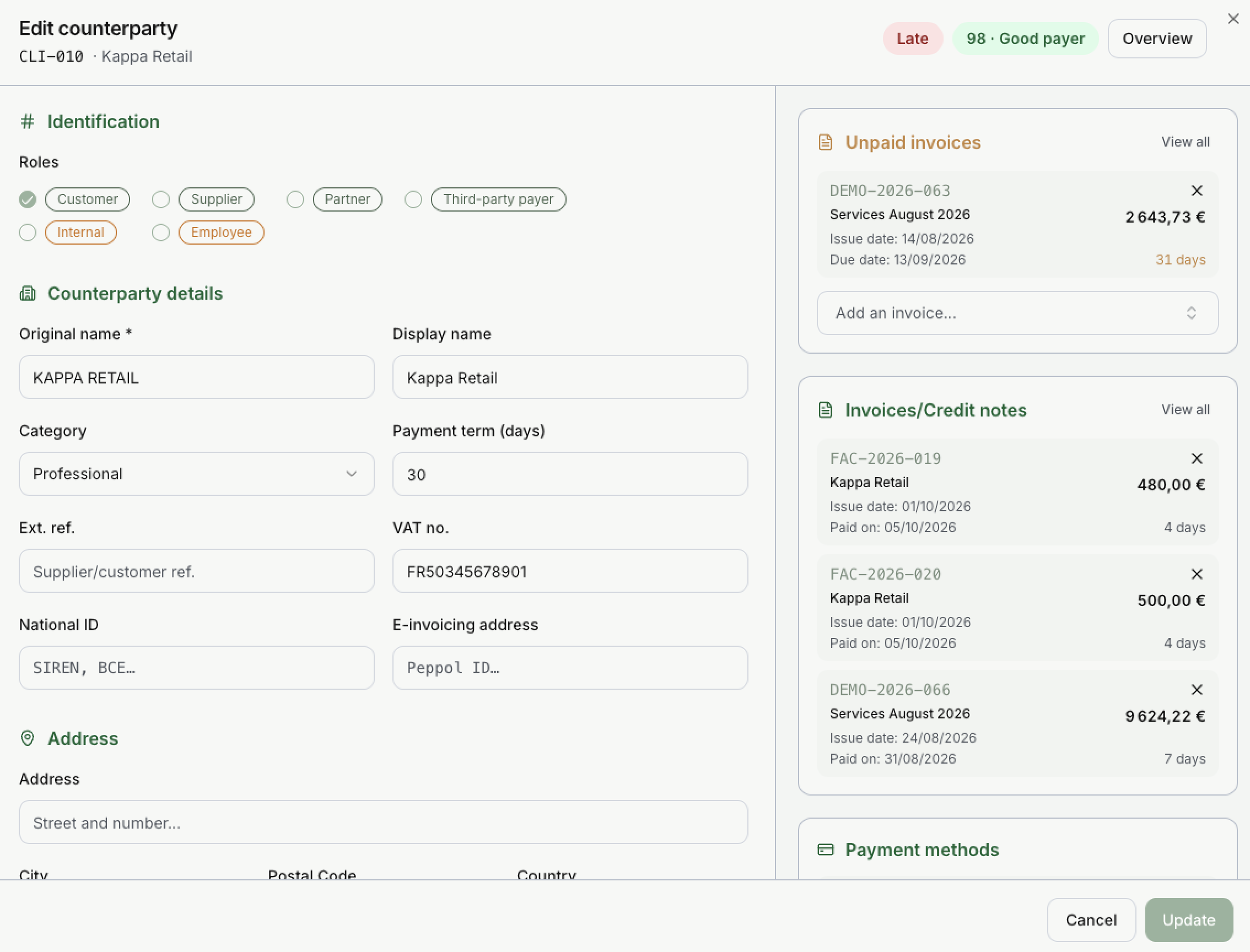
At the top, the panel shows the code, the name, the status and the payer score. Overview opens the full page of the counterparty. See Overview page.
In this example, Kappa Retail is Late because invoice DEMO-2026-063 was due on 13/09/2026 and is still unpaid, 31 days later. It is still a 98 · Good payer, because it paid its other invoices within a few days.
Identification
Counterparty code. Unique in your Entity. Choose Auto and Invunion gives the next free code: CPT-001, CPT-002, and so on. Choose Custom to type your own, for example the code from your ERP. The code is what the API uses, and it helps a lot to recognise the customer when you import invoices.
Roles. Tick one or more. A new counterparty is a Customer unless you change it.
| Role | Use it for |
|---|---|
| Customer | Someone you invoice. Most reconciliation work is about customers. |
| Supplier | Someone you buy from. |
| Partner | A partner company. |
| Third-party payer | Someone who pays for a customer, such as a parent company or a factor. |
| Internal | A company of your own group. |
| Employee | A person who works for you. |
Green roles are outside parties. Orange roles are on your side.
Counterparty details
| Field | What it does |
|---|---|
| Original name | The legal name. Required. Invunion compares it with bank lines and invoices. |
| Display name | A shorter name shown in lists. |
| Category | Professional, Individual or Governmental. Professional by default. |
| Payment term (days) | Whole days from 0 to 365. Used to set a due date when an imported invoice has none. Leave it empty to use the default of your Entity (30 days unless changed). It never replaces a due date that is already on the invoice. |
| Ext. ref. | The reference of this customer in another tool. |
| VAT no. | The VAT number. |
| National ID | The company number, such as a SIREN or a BCE number. |
| E-invoicing address | The Peppol ID, for e-invoicing. |
Below come Address, Contacts (phone and email), Accounting (Analytic 1 and Analytic 2), and Metadata.
Metadata holds anything that has no field of its own, such as a CRM ID or the name of the person who chases payments. Keys that start with _ are hidden in tables.
Invoices and payment methods
On the right side of the panel:
- Unpaid invoices: the invoices still to be paid. The orange number is how many days they are overdue.
- Invoices/Credit notes: the paid documents, with the number of days it took to be paid.
- Payment methods: the IBANs, account numbers and other payment methods of the counterparty. Account numbers are stored encrypted and shown masked.
Use Add an invoice… to link an invoice to this counterparty, and to unlink one. Nothing is saved until you select Update.
System counterparties
Every Entity has two counterparties created by Invunion. You cannot delete them, and they never get a payer score.
| Code | Name | What it is for |
|---|---|---|
SYS-CPT-001 | Unclassified | Invoices and transactions that Invunion cannot link to anyone land here. Credit from the customer wallet is never applied to it. |
SYS-CPT-002 | Own accounts to assign | Your own bank accounts that were found but not yet linked to an Internal counterparty. Move them to the right one. |
They are listed first when no filter is active.
Other ways to create counterparties
| Source | What happens |
|---|---|
| Add | You create one counterparty. |
| Import | You create many at once from a CSV file. |
| API | One at a time, or up to 500 per call. See the API reference. |
| Invoice import | When an imported invoice names a customer Invunion does not know, the customer is created. |
Each new counterparty also gets a Default payment method. It is the place where its IBAN or other identifiers go later. If you give an IBAN at creation, the payment method is created at once.
Limits to keep in mind
- A name in a bank line that looks like a customer is not proof on its own.
- Some payment providers send money for many customers from the same account. Their payment method may not belong to one counterparty.
- Supplier invoices and outgoing expenses are not reconciled yet, even if the supplier exists as a counterparty.
Updated · View as Markdown